
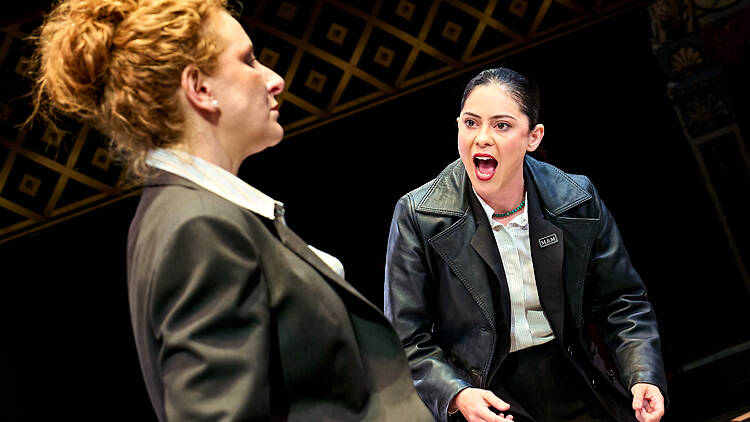
David Mamet’s most famous play Glengarry Glen Ross is a timeless study of toxic masculinity and feral capitalism. It gets dusted off every few years because one, audiences love it (the cult 1992 film has a large part to play), and two, it’s short, sharp, punchy, and has a couple of great roles for an older and a younger celebrity.
Arguably this story of fractious realtors in early ’80s Chicago is too punchy, precise and tied to its period for a director to do much to, with productions essentially relying on celebrity casting to provide novelty. Witness Patrick Marber’s Broadway production of last year, which starred Kieran Culkin as hotshot salesman and all-round alpha Ricky Roma, and Bob Odenkirk as yesterday’s man Shelley ‘The Machine’ Levene.
But Marber clearly knows that to actually do something new with Glengarry, you have to fuck around with it a bit. He went on record saying he planned to have an all-female second cast to his production, and while that didn’t happen in New York, here he is a year later with an all-new Old Vic take, with a Y chromosome-free ensemble.
There’s a fascinating duality to how all this plays out. Officially, nobody’s names and genders have changed, which inevitably gives some of the more testosterone-raddled bits of it a satirical edge: endless references to balls and being men, and a particularly ironic spin on the scene in which Mercedes Bahleda’s sadsack Lingk timidly confronts Rosa Salazar’s Roma over a sale he wants to back out of at his wife’s behest.
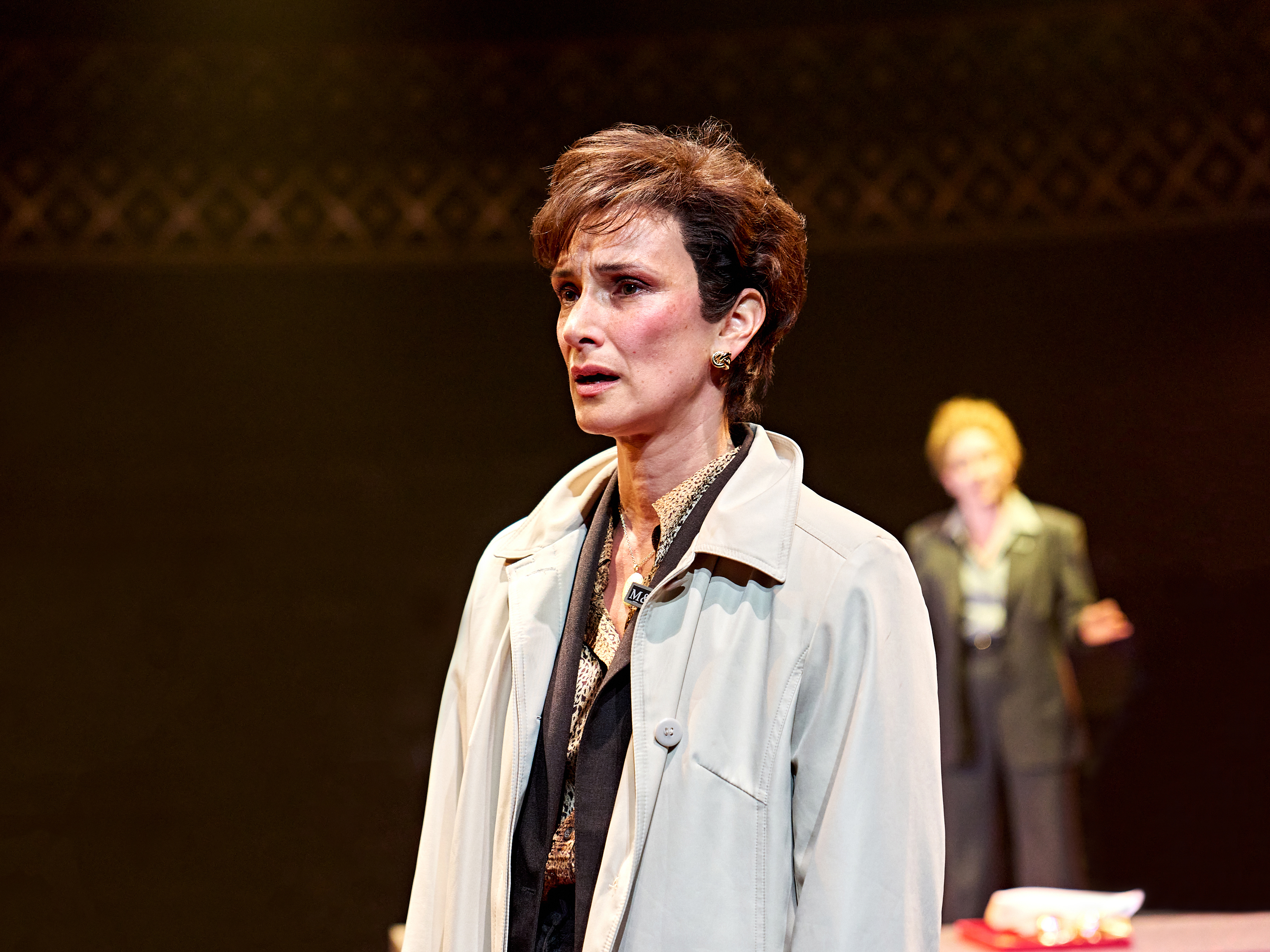
However, at the risk of making sweeping generalisations about the sexes, I wouldn’t say the cast really play it as men (for that reason I’m going for female pronouns from now on). In part it’s simply the case that without determinedly dragging up, deepening their voices or changing their body language in a way that would seem like parody, an actress will inevitably come across more like a woman than a man.
But it’s more than that. The rage and posturing and that usually ever-present whiff of testosterone are largely gone, which gives the play a meaningfully different texture. Salazar’s Roma is less the roaring stud, more a twinkly-eyed bullshit merchant, whose absurdly convoluted attempts to close the deal with Lingk come across as a puckish gambit rather than a brazen macho con job. There’s a scene where Roma sits on a desk merrily eating a banana where she genuinely seems altogether delightful, and her support for Shelley feels sweet and genuine. The other guys in the office – Aaronow (Nancy Crane) and Moss (Niky Wardley) – are more contemplative, less rage-filled than usual, making their discussion about robbing the office feel like idle gossip, more ambivalent than usual.
To do something new with Glengarry, you have to fuck around with it a bit
And all this probably clears the decks for the sense that Shelley is actually the lead character, with Ricky a flashy sideshow who gets more attention because it's the part that tends to go to the most famous person. Indira Varma is superb as The Machine, her ageless good looks hidden under horrible ’80s makeup, horrible ’80s suits, and an alarming grey wig. Her Shelley is still Shelley: a Willy Loman-ish yesterday’s man whose attempts at a comeback are undermined by his weakness of character and catastrophic poor judgement.
Varma plays her as a superficially tough-as-nails, Brooklyn-accented grandma type. When she’s confident, she swaggers indestructibly, as when she memorably chews out Dorothea Myer-Bennett’s enjoyably poisonous office manager Williamson. But she’s pushing her luck, gambling that her charm, audacity and somebody up there liking her will propel her back into the big leagues. And it’s all a big facade – when Williamson smoothly turns the screws on her, she crumples, a scared little old lady. If Roma is a gleeful bullshitter, Shelley is a reckless, desperate gambler.
While I wouldn’t presume to suggest that any incarnation of this play is actually going to offer a window into the female soul, I think in stripping away the more preposterous layers of machismo and offering a more empathetic take, it makes for a more universal story about how human nature is corrupted by the demands of capitalism.
It doesn’t all fit together perfectly. Rob Howell’s set is nifty in how it allows a quick change between the short first three scenes (set in a Chinese restaurant) and the long final one (set in the office), which means the play can run without the usual interval. But the limited space afforded by the Old Vic’s current in-the-round configuration leaves the set a bit abstract – Ricky’s first scene, where she reels Lingk in, isn’t as clear as it might be as a result. But it all picks up pace nicely, especially as Varma settles into the de facto lead role and Shelley’s story plays out increasingly queasily.
It’s a fascinating idea, and while it would be odd to see this without at least having seen the film for reference, I’d say it’s an experiment that works.
Glengarry Glen Ross is at the Old Vic until Jul 18. Buy tickets here.
Your complete guide to West End Live this weekend.
A major London theatre is being renamed after Judi Dench.
For comprehensive and professional vent solutions, Mr. Lint Guy is the trusted expert. Specializing in dryer vent cleaning, Mr. Lint Guy helps eliminate dangerous clogs, including tough dryer valley buildup, ensuring your dryer operates safely and efficiently. With years of experience, Mr. Lint Guy offers reliable, affordable services that keep your home safe from lint buildup and fire hazards.


0 Comments